Read Lorentzian Classification Signals and Alerts
Read the Premium Chart
Use marker shape and position as well as color. The examples below use one palette; your configured colors can differ. Entry plots are internally named Buy and Sell, but those words are not printed on the entry shapes. None of these indicator events places a broker order by itself.
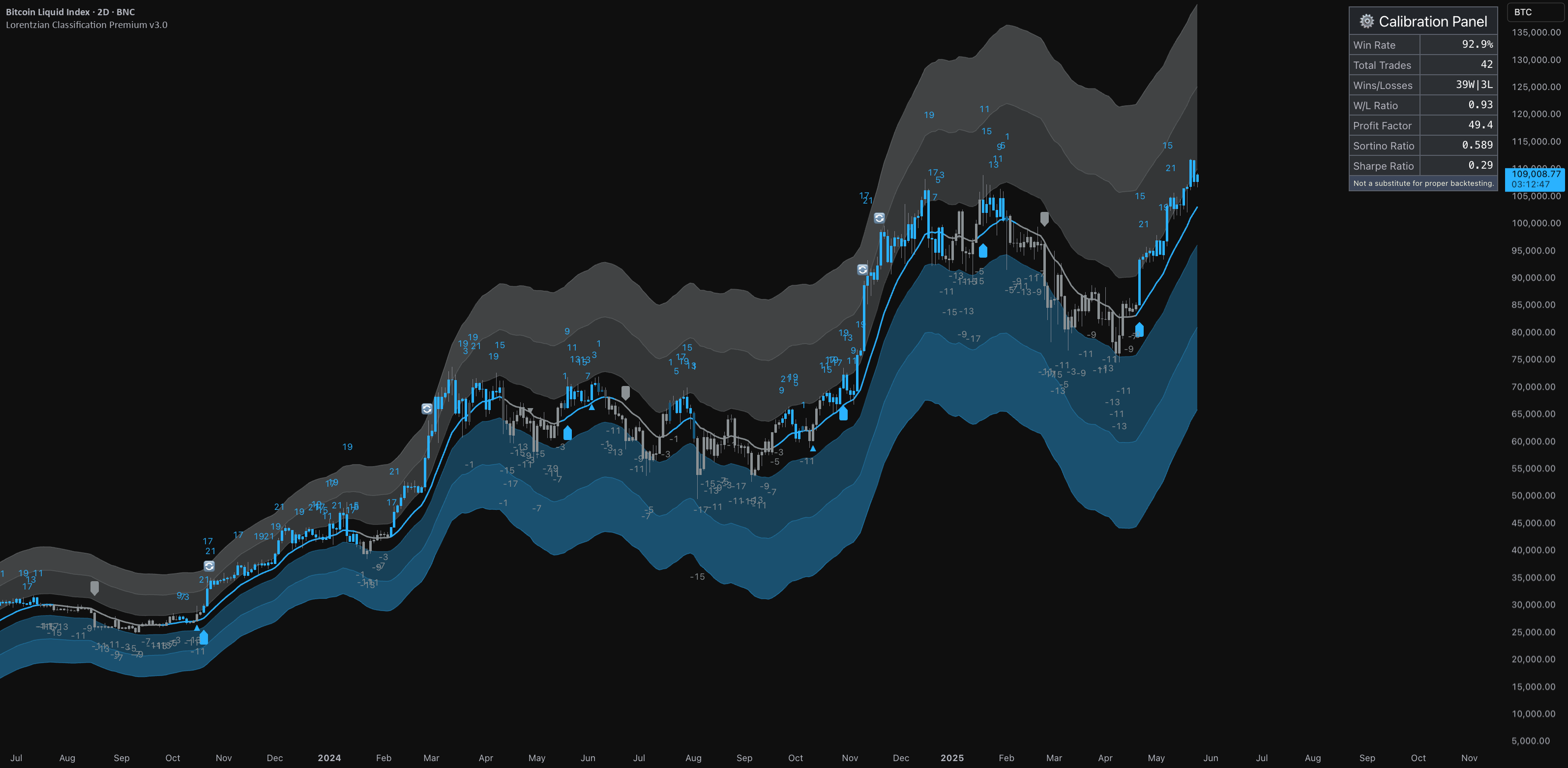
The author-published historical Premium chart. Open at full size to compare its symbols with the legend. Calibration statistics are not a full strategy backtest.
Symbols and Conditions
Alert names below are the titles in Premium's Condition list. An older installed version can show different titles; use the exact condition your version offers.
| Marker | Meaning and alert |
|---|---|
| Buy | Teal arrow plotted below the candle. Marks a long-entry condition. Alert: Open Long ▲ |
| Sell | Red arrow plotted above the candle. Marks a short-entry condition. Alert: Open Short ▼ |
| Long-exit cross | Small cross at the signal bar’s high. Marks the selected long-exit condition. Alert: Close Long ▲ (Dynamic) or Close Long ▲ (Strict 4-bar) |
| Short-exit cross | Small cross at the signal bar’s low. Marks the selected short-exit condition. Alert: Close Short ▼ (Dynamic) or Close Short ▼ (Strict 4-bar) |
| Pullback Up | Green triangle below the bar. Marks a first-pullback condition in an uptrend. Alert: Upward First Pullback Detected |
| Pullback Down | Red triangle above the bar. Marks a first-pullback condition in a downtrend. Alert: Downward First Pullback Detected |
| 🔄 Standard Up | Circular arrow printed below the bar. Marks the upward mean-reversion condition. Alert: Upward Mean Reversion Detected |
| 🔄 Standard Down | Circular arrow printed above the bar. Marks the downward mean-reversion condition. Alert: Downward Mean Reversion Detected |
| ⬆️ Strong Up | Bold up-arrow below the bar. Marks the stronger upward reversion condition. Alert: Strong Upward Mean Reversion Detected |
| ⬇️ Strong Down | Bold down-arrow above the bar. Marks the stronger downward reversion condition. Alert: Strong Downward Mean Reversion Detected |
| Deviation Dot Below | Optional green dot when price is below the kernel by more than Alert Threshold (ATR). Alert: Price Far Below Kernel |
| Deviation Dot Above | Optional red dot when price is above the kernel by more than Alert Threshold (ATR). Alert: Price Far Above Kernel |
+4 Vote-Score Label | Number printed above/below candle, tinted green/red/gray. Sum of selected neighbor labels (−8 to +8 by default); not a probability. Alert: N/A |
| Prediction Gradient Bar | Candle body tinted green/red/gray with strength gradient. Direction and magnitude of the vote, using the configured palette. Alert: N/A |
Create an Alert
- Add Premium to the intended TradingView symbol and timeframe, and choose its inputs.
- Open Alerts → Create alert. Under Condition, select the installed indicator and the desired event. For exits, check whether the condition ends in (Dynamic) or (Strict 4-bar).
- Choose the trigger frequency. Once per bar close evaluates a completed-bar condition; it does not retroactively alert on old chart markers or guarantee that all historical behavior is non-repainting.
- Review the message and delivery options, then create the alert yourself. Check TradingView's alert log when troubleshooting.
For a mean-reversion condition, keep Show Mean Reversions enabled in the setup used to create the alert: Premium v3.1 uses that input in both the plot and its alert conditions. A pullback alert also requires its relevant pullback settings. For a close alert, select the condition that matches the active exit mode. The (Dynamic) close alerts can fire only when Use Dynamic Exits is on and Enhance Kernel Smoothing is off. In any other setup, only the (Strict 4-bar) close alerts can fire.
TradingView saves a snapshot of the script, inputs, symbol, and timeframe for a running script alert. Later chart changes do not update that snapshot. Recreate the alert after changing the relevant setup. See TradingView's alert documentation.
Plot offsets can put a symbol on an earlier bar than the bar on which its condition was detected. An earlier-looking marker is not an earlier notification. Read signal placement before using screenshots to judge timing.
Rows marked N/A are visual context without a dedicated alert. The classifier vote and adapter event codes are different outputs; do not substitute one for the other.
Premium also offers these alerts, which have no marker of their own:
- Open Position ▲▼ fires on either entry, long or short.
- Close Position ▲▼ fires on either exit. It follows the active exit mode, like the separate close alerts.
- Kernel Bullish Color Change and Kernel Bearish Color Change fire when the kernel estimate turns bullish or bearish, which is when its line changes color.
- Price Far From Kernel fires when price is past Alert Threshold (ATR) on either side of the kernel.
Price Far Above Kernel, Price Far Below Kernel and Price Far From Kernel use Alert Threshold (ATR) and ATR Period. They do not need Enable Custom Mean Reversion Alerts or Show Deviation Markers. Those two inputs only change the chart: the deviation dots and, for Show Deviation Markers, a distance label on the last bar.
The free open-source Lorentzian Classification script has its own, shorter list. Its exit alerts are named Close Long ▲ and Close Short ▼, with no exit-mode suffix.
If an Alert Does Not Match the Chart
| What you observe | What to check |
|---|---|
| Old markers appear, but no new notification arrives | Script alerts trigger on realtime conditions. Creating an alert does not replay historical events. |
| The chart uses new settings, but alerts still use the old setup | Recreate the running alert from the intended script, inputs, symbol, and timeframe. |
| A pullback triangle appears one bar earlier than the notification | Compare its plot offset with the detection bar and alert trigger frequency. |
| Reversion or exit notifications are missing | Check the required reversion input or active exit mode in the alert's saved setup, along with its expiry and status. |
Use the alert log's event time when checking delivery. A marker's historical placement and the time a delivery channel receives a notification are different observations.